Friday, April 16, 2010

Conclusion of Fallout 3: What I've Learned

Education 222 is all about video games and learning, so I would be remiss if I didn't conclude this series of posts talking about what I learned from Fallout 3.

Lesson # 1: Actions Have Consequences

Oops

While in games such as Grand Theft Auto, you can go around shooting people in the face and blowing up cars and as long as you run away from the police for a couple of minutes everything is ok, your actions in Fallout 3 can come back to bite you. If you ever kill someone who you're not supposed to or steal something from a locked cabinet, you lose Karma, which gives you bad luck throughout the game and causes characters to interact with you differently. Last week, I was posed with an ethical dilemma - should I or should I not detonate the atomic bomb in the middle of Megaton. I did a little experiment - I saved right before the mission in which you have the option to detonate the bomb. In one game, I diffused the bomb and I became a hero throughout the town, so much so that a couple of residents decided to be my companion on my journey. However, in the other game, I decided to detonate the bomb. Instantly, I lost about as much Karma as you can lose - but how many chances does one have to cause an atomic explosion? It was worth it. However, as I played throughout the game, whenever I walked by people would cower in fear. Occasionally, I would be attacked by some survivors of Megaton. Luckily, since I had leveled up so much, I was able to dispatch them easily.

Lesson No. 2: You're Never Better Off Alone

Aawwwwww

Much of Fallout 3 involves wandering through a vast, empty wasteland, so it's nice to have some company. I had heard before I started playing this game that it was possible to get a dog to follow you around. I was wandering through a Scrapyard, and I encountered a large group of Raiders. I was outnumbered and about to be killed, but out of nowhere came the insensitively named "Dogmeat", who helped me fight off the Raiders. Ever since then, Dogmeat (hate calling him that) has been following my character through all his travails, helping me in my journeys and protecting me from some smaller attackers, such as rats and giant radioactive bugs.

Lesson No. 3: Ration Ration Ration!
If you're living in an apocalyptic wasteland, there's probably not much food to go around. Therefore you have to save what you got. After a particularly long trek through a desert, my character was about to starve to death. Luckily, I had some iguana bits in my back pocket. Doesn't sound appetizing, but you'd eat it too if you were about to die.

Lesson No. 4: Mastery of the Semiotic Domain
James Gee says that each game is a world to itself and as you spend time in that world and grow more familiar with it you learn how the world works. This clearly happened for me in Fallout 3. As I played more and more, the controls became second nature and I understood which responses to give to NPCs and what items to use as a second nature.

There are many more things that I learned from the game. I am nowhere near completing it. There are still many side missions and story missions that I need to complete. However, playing through Fallout 3 has been as spectacular experience, and I would recommend it too gamers and non-gamers alike.

Another note: Just because I am done with the game, probably doesn't mean I'm done with the website. I like the name that I chose too much, and I feel like I could find something to talk about most days. But it has been fun. Have a great summer, everyone.

Monday, April 5, 2010

Non-Playable Characters


In class, we've been talking about MMORPGs, or Massive-Multiplayer Online Role Playing Games, like World of Warcraft and Second Life. Fallout 3, unfortunately, does not have any online elements to its play. However, Fallout 3 manages to avoid the lack of interacting with real people by introducing a cadre of interesting non-player characters.

One is Lucas Simms.


Hi, Lucas!

As you can probably tell from his clothes, he's an aficionado of Old West stories. He is the elected sheriff of Megaton and wears the star just like Gary Cooper in High Noon and has a rifle slung across his back just like John Wayne. Luckily for Lucas, but not as lucky for the rest of us, the USA has turned into an atomic wasteland, where only frontier justice reigns. Lucas has to protect his town from unimaginable terrors.

My favorite NPC, however, so far, might be Moira Brown.

Moira is a mechanic, who, despite her desperate surroundings, is unusually happy, almost bubbly. Moira is a great contrast to the depressed, laconic individuals that populate this desolate world. Moira is very helpful, as well, as she sells me supplies, such as weapons and food. Moira is attempting to write a book called The Wasteland Survival Guide and has enlisted my help.

While these NPCs are very interesting, they still are not a substitute for actual human interaction. Each interaction with these NPCs is governed by the response given to you by the game, based on your character's attributes. True conversation is impossible with these characters. Also, it is impossible for them to truly aid you on quests, because they will not always respond the way you want them to. However, these NPCs allow the makers of Fallout 3 to advance the story and to use the interactions between the player and NPCs to develop the character and enrich the environment of the game.

Wednesday, March 17, 2010

VATS

One of the most important aspects of Fallout 3 is the aiming and targeting method used. Instead of just pointing and shooting like in most video games, my character in Fallout 3 uses the Vault-Tec Assisted Targeting System (VATS) in order to get the best hits on a target. The VATS allows works with all types of weapons, from baseball bats to mini-thermal-nuclear-missile luanchers, and is one of the most unique and fun parts of playing through the game.

The VATS allows for more accuracy when using any type of weapon. Activating the VATS will bring up an interface, showing the potential targets in the area and their most vulnerable parts. The VATS will also show you the probability that you will hit the particular body part of the target. You can choose to shoot to kill, a headshot, which is less accurate or you can aim to maim by shooting your target in the leg. This will bring up an interface that looks like this:

As you can see, the best option would not be to hit the heavily armored torso, despite its 95% hit chance, or his head, which offers a 35% chance, but his right arm, which wields a weapon. A shot from a powerful gun will likely disarm him.

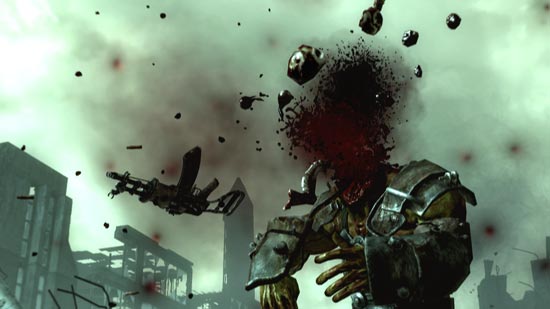
The VATS also makes Fallout 3 more fun for the teenaged boy in all of us, by showing a slow motion animation of the bullet hitting the target, which may result in something like this:

Victim of Vault technology

The VATS is also practical from a game design perspective because of how having to worry less about shooting accuracy will allow gamers to focus more on the more immersive parts of gameplay, such as map exploration, engaging with NPCs and item collecting. Simplifying the most fun part of the game makes the challenges that the other aspects bring more rewarding.

Friday, February 19, 2010

Radio Free Wasteland

After spending some quality time in Megaton, my character hacks into the Saloon Owner's computer to find out where my father could have gone off to. I read about Galaxy Free Radio, which broadcasts hope to the Wasteland and apparently my father went off to "fight the good fight." I decide to wait until daybreak to leave Megaton and find my father.

I spend the night wandering around Megaton, talking to the natives and exploring the buildings. I meet interesting characters such as Mother Maya, the spiritual leader of the bomb-worshipping Children of Atom, and Jenny Stahl, who runs the local restaurant, with a menu filled with dirty water and squirrel stew. The local old woman, Manya, tells me about he dangers that lurk outside the walls, Raiders, Supermutants, etc. which I am sure to encounter later in the game. First, I want to stock up on weapons, before I leave the relative safety of Megaton and wander in the Wastes.

Playing this game, I continue to be astonished by how every little object and character in this game is important. The possibilities of where I can go from here are mind-boggling, and a little confusing. There are so many options that I don't know what exactly I want to do. It's great to have this much freedom in a video game, as it allows for much interactivity and helps me learn.

Friday, February 5, 2010

Exploring the Capital Wasteland


Unfortunately, my gameplay this week did not have much to do with the readings. The readings were about how technology should be implemented into schools to help stimulate students' learning experiences. In the last time I played, my character took an aptitude test called the G.O.A.T. - or Generalized Occupational Aptitude Test - which featured questions like "You are approached by a frenzied vault scientist, who yells, "I'm going to put my quantum harmonizer in your photonic resonation chamber!" What's your response?" This seems to be going in the opposite direction of the way schools are actually heading. However, one can assume that the apocalypse made humans more primitive, employing standardized tests as the only qualifier for future employment.

    Gameplay this week was incredibly interesting. After my character escaped the Vault, I had a chance to explore the outside world. The outside world is a vast wasteland, free of cars, people or plants or anything signifying our presence on Earth, except the crumbled ruins of an old city, presumably Washington DC. I have to fight feral dogs and mole rats and two headed cows and I find a city called Megaton. The city is a fortress in the middle of the wasteland. The interesting thing about Megaton is an un-detonated nuclear bomb lies in the middle of the city. Some people in the city even worship the bomb

    The most interesting part of my trip is how my walks around the apocalyptic wasteland was accompanied by 40's big band Jazz, making my proceedings even more ominous and creepy. I can't wait to delve even deeper into the game next week.

    Friday, January 29, 2010

    Meet Max Power


    "War...war never changes"

    Unfortunately, I did not have much time to play Fallout this week, so this will be a brief post. I only had time to create a character and select his attributes.

    The first thing that you see when you play Fallout 3 is a hula doll on the dashboard of a bus, which is eerily accompanied by a 40's big band song about setting the world on fire. The camera pans out to find the bus empty, with a teddy bear on one seat. Further panning reveals the bus is destroyed, along with most of the city it once belonged in. Next you hear a voice over explaining the world of Fallout. Basically, the world is in a state of nuclear holocaust, after a giant nuclear war. Unfortunately, the war still continues. Citizens must go underground into vaults set up by the government. However, most of the vaults were destroyed and the people in them were forced to emerge. Except Vault 101, which is" where you were born and where you will die"

    Surely enough, I witness my own birth and choose my key attributes. Interestingly, my father is Liam Neeson. Liam Neeson names me Max Power (after a Simpsons episode that he loves so well. Actually, I chose the name.) Now I choose what I want my character to look like. Do I want to make a character that looks just like me, or should I make myself look ridiculous. Action hero or every man? I choose preset 2, which seems to be in between action hero and everyman. Interestingly, he looks a hell of a lot like Luke Skywalker, which is not much of a problem for me. I add a beard, because this is post-apocalyptic society and who does not grow a beard after the apocalypse. Basically, he's Mad Max.


    Sadly, my mother dies of childbirth, despite the presence of much medical equipment. I get to learn how to walk when I'm a baby. I get to choose more attributes about my personality. I decide to add personality points to my intelligence, charisma, strength and luck. A good balance. You always want luck. Eventually, I grow up, into a ten year old, and I have a birthday party, which gives me a device called the Pip Boy 3000, which tracks my stats. I have various interactions with NPCs, which helps form my personality.

    Next, I have to take an exam, to determine even more of my attributes. Next thing I know, I'm 19 years old and I have to escape the Vault or I'll die, since my father is now a fugitive. After killing the Overseer of the Vault, I escape into the outside world.

    Fallout has succeeded in creating an immersive world that you don't want to leave, a great motivation to keep returning to the game. The evolution of your character also acts as a pull to return to the game.

    I look forward to making progress in the world of the unknown

    Friday, January 22, 2010

    Introduction

    Welcome to the Cobert Report. I'm Dan Cobert and I'm setting up this blog for the University
    of Michigan class Education 222, Video Games and Learning. This semester, I'm playing
    Fallout 3, a post-apocalyptic adventure role-playing game made by Bethesda Softworks.Bethesda is famous for its massive, sprawling role-playing games that take dozens of hours to complete. The Elder Scrolls series, particularly the fourth installment, Oblivion, allows the player complete freedom to explore the game’s expansive world, using a character with many customizable features. As a huge fan of Oblivion, I was beyond excited when Bethesda’s next epic, Fallout 3, came out in October of 2008. However, as I had just started my freshman year of college, I was not able to find the time to enjoy any single-player story-based games, which I used to love in high school. Choosing Fallout 3 to play this semester would scratch a personal itch that I’ve had for over a year.

    As Fallout was one of the best reviewed games of the decade, I felt like I would do myself a disservice by not playing it, and seeing what I could learn from it. During my exploration of this game, I'm gonna remark on the things that I find particularly fun or interesting, as well as the aspects of the game that correspond to James Gee's principles of learning, which can be applied to video games. Tune in next week, when I dive into Fallout 3 and dwell on the social implications of the game's doomsday society.